スウェーデンの国民的作家が生んだ 手のひらに宿る北欧の物語
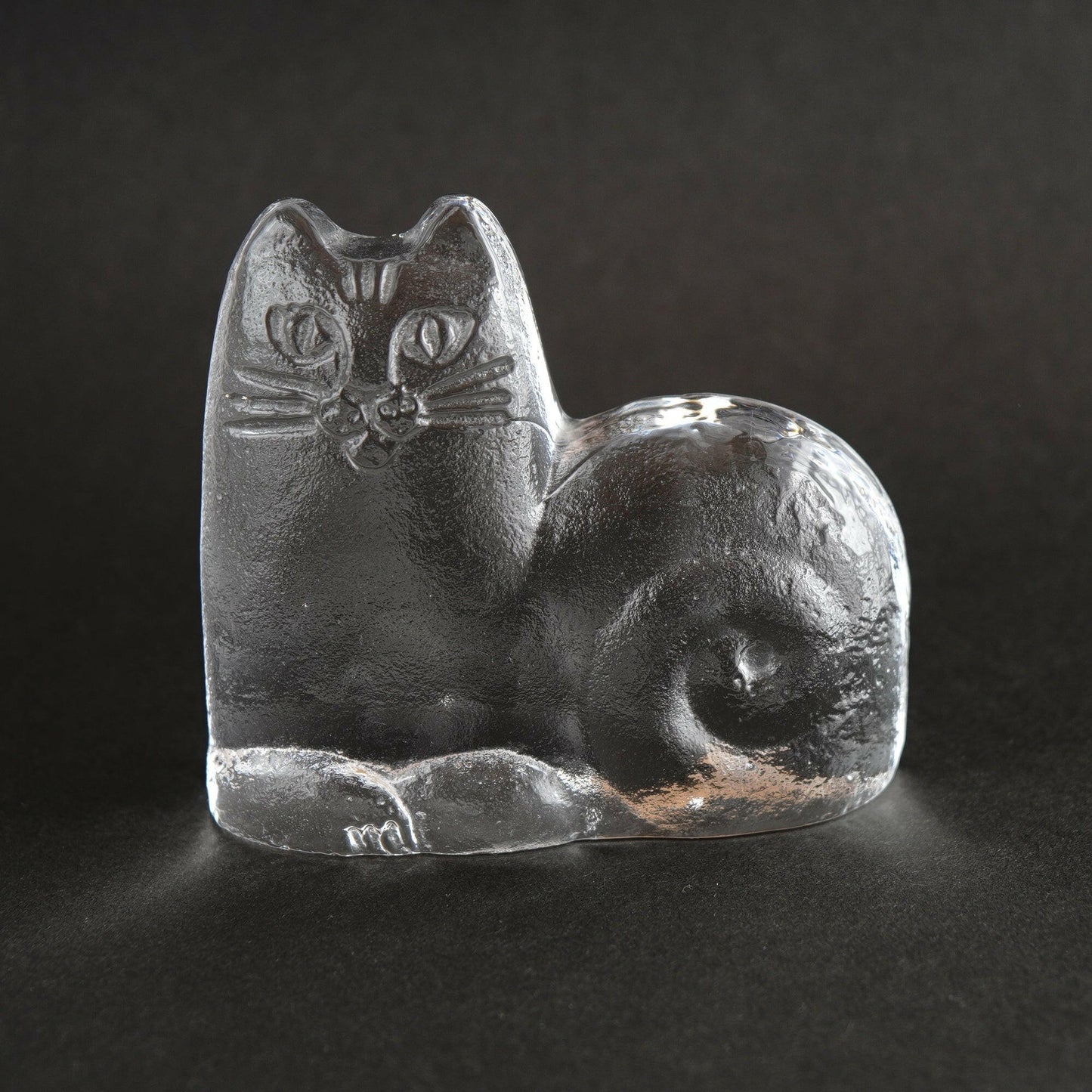
Crystal glass cat figurine designed by Lisa Larson in the 1980s. After leaving Gustavsberg in 1980, Lisa Larson received requests from companies around Europe as a freelance designer. This is a cat object that was commissioned by a glass maker in Sweden called Royal Krona during my free time.
Lisa Larson likes to use a lot of cat motifs, but what she has in common with ceramic plates and figurine forms is that she has a large face and a small expression in the center. With this exquisite balance, Lisa Larson's cat design exudes a unique cuteness. The tail is represented by a spiral, and the hands are neatly piled up and looking forward. The glass is highly transparent, and when viewed from various angles, the expression is subtly different. Please enjoy it as an ornament.
■Details Manufacturer: Royal Krona Designer: Lisa Larson Age: 1980s Country of Origin: Sweden Condition: ★★★★★ (5: Complete)
The original seal remains on the back, and it is a very beautiful product that retains its original appearance without cracks, chips, or scratches.
■ Lisa Larson (1931- )

Born in a village called Härlunda with a population of about 500 in the Älmhult district of the Kronoberg county in the Småland region in southern Sweden. When I was young, I wanted to be a fashion designer, but after entering the Gothenburg College of Art, I learned ceramics. At one point, Stig Lindberg discovered him in a competition, and after a one-year trial period, he officially joined Gustavsberg as a designer. Soon after, in 1955, he announced the Lilla zoo series, and in 1964 he devised the famous Afrika series of lion statues.
In addition to Gustavsberg, Lisa Larson has also designed for Höganäs, national retail giant Åhléns and German pottery manufacturer Rosenthal. After leaving Gustavsberg in 1979, he took the position of a freelance artist who entered into freelance contracts with companies rather than working exclusively with them, and continued his creative activities freely while working in various fields. In 1979 and 1981, he held solo exhibitions at the Seibu Department Store in Tokyo, and it is said that 70,000 people visited the solo exhibition in 1981.