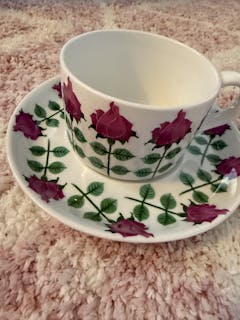
わずか2年で消えた幻のアヤメ 大容量ティーカップの贅沢
| Detailed specifications | |
| Manufacturer | ARABIA |
| designer |
Form design: Peter Winquist Pattern design: Esteri Tomula |
| Series name |
Krokus |
| Year | 1978-79 |
| Country of manufacture | Finland |
| condition |
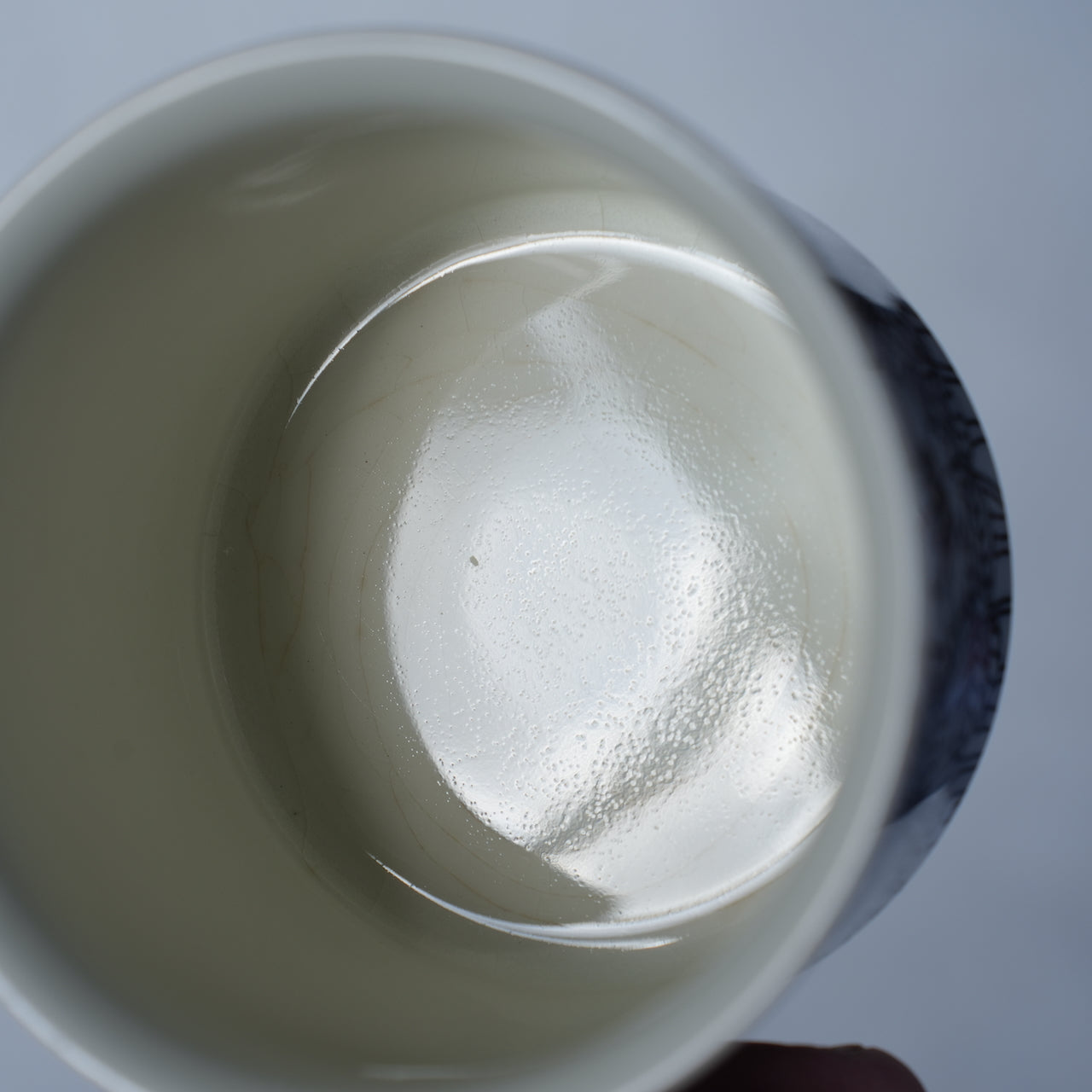
Reason Crazing can be seen in the center to bottom of the cup handle, the bottom inside the cup and the high part. Crazing is a crack that runs on the glaze surface during the firing process in the manufacturing process and is not a scratch in use or damage to the body itself. There is no problem with use. The surface of the saucer can be seen slightly scratched when held up to the light. |
| size | Cup diameter 9.3cm Height 6.5cm Saucer diameter 17cm |
This is a rare teacup and saucer from the Crocus series, a masterpiece by ARABIA, a leading tableware manufacturer in Finland. The Crocus series name comes from a type of iris flower. The designer is Esteri Tomura, known for Flora, Valm, and Botanica, and is skilled at incorporating natural flowers into his designs.
The Crocus series comes in three versions: black and white, color, and black and white with gray rim. This is the relatively rare black and white version. Crocus was only manufactured for two years, from 1978 to 1979. Reproductions have been sold in recent years, but they are different from the vintage versions in that they are not as original, such as the shape is a little too sweet and the mugs are not included in the original.
This teacup and saucer is a particularly rare large size among vintage Crocus pieces, and was produced in very small numbers. It is a rare item that is rarely available on the vintage market.
Compared to smaller coffee cups, this teacup size has a fairly high percentage of crazing in the cups. With the ARABIA pottery technology of the time, the larger the cup, the more likely it was to have crazing, but the large, thin Crocus teacups were more likely to have crazing during the manufacturing process. For this reason, small coffee cups that are less likely to have crazing were mass-produced, It is believed that the number of teacups produced in the first place was low, and as a result, Crocus teacups have become a rare item.
ARABIA - Arabia

ARABIA is a ceramic manufacturer representing Finland in the 20th century. Originally, ARABIA was a factory established in Finland by Sweden's Rörstrand as a base for producing pottery for Russia. The company's name comes from the fact that it was established in the Arabian district of Helsinki, the capital.
From the 1950s to the 1980s, many world-famous designers such as Ulla Procoppe, Birger Kaipiainen, Laiya Uosikkinen, and Esteri Tomura created many works, known as the Golden Age of ARABIA. Works that had a great influence on modern modern design were created at the time, from simple Scandinavian modern designs to highly decorative and well-crafted pieces. ARABIA is known for its masterpieces such as paratissi, crocus, flora, and corari, which are both practical and decorative items unique to Scandinavian tableware that are useful for both interior and everyday use.
Esteri Tomula

Esteri Tomura (1920-1998)
Born in Helsinki, the capital of Finland. Her father, who was a university professor, bought a villa in the countryside called Urjalan in northwest Helsinki, and her childhood was spent every summer at the villa with her family, which was rich in nature, which deepened her knowledge of nature. be done. Esteri Tomura had a congenital condition called dwarfism, and initially majored in ceramics at Aalto University of the Arts in Helsinki, but due to physical reasons, she was unable to work with clay satisfactorily. Therefore, he gave up on the career of ceramics and sought his own expertise in design.
After joining ARABIA , he honed his skills as a pattern designer with Laiya Uosikkinen, who became his lifelong friend. While Uosikkinen preferred abstract and geometric patterns, Tomura seeks the origin of his designs in the flowers and flowers of Finland, which was the original landscape of his childhood. Tomura, who created masterpieces despite his physical handicaps, has similarities with Birger Kaipiainen, who designed the timeless masterpiece Paratissi despite suffering from polio.