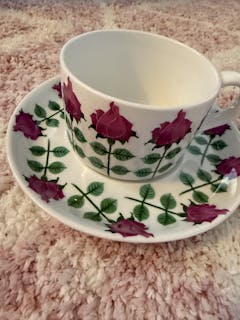
This is a vintage 25cm oval plate (dinner plate) from the famous Paratiisi series by the Finnish company Arabia. The Paratiisi series, which means paradise in Finnish, was designed by Birger Kaipiainen in 1969. He also designed a monochrome version of the series in 1972.
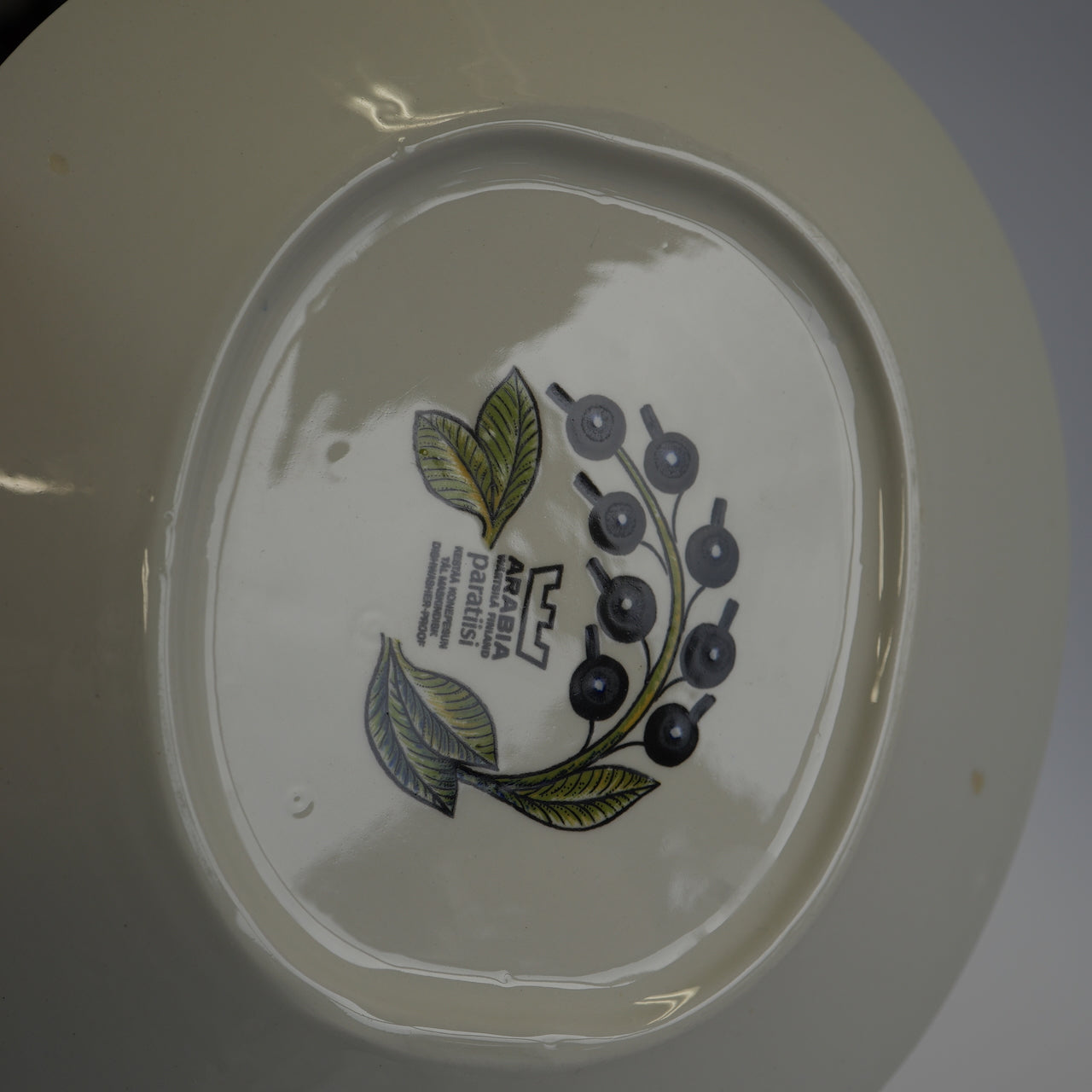
Paratiisi production ceased in 1974, but the series of the same name was revived in 1988. However, the shapes of the Finnish plates made after 1988 were different, and the plates were changed from the previous oval shape to a circle. This is a vintage oval plate made in Finland in the 1970s. It is characterized by a wing-like leaf protruding from the left side of the logo.
Currently, Paratiisi plates are being produced in reproduction, all made in Thailand. The reproductions are characterized by a clear, deep surface paint color and a striking white base. The original plates were painted in a lighter color, and each plate has its own unique color.
■Details Manufacturer: ARABIA Designer: Birger Kaipiainen Series: Paratiisi Year: 1971-1974 Country of Origin: Finland Condition: ★★★★☆ (4: Excellent condition)
When held up to the light, cutlery marks can be seen on the surface and edges. The color is beautiful and the product is highly finished, with no cracks, chips or crazing.
■Size: Width 25cm, Height 3cm


Paratiisi ~ Finland's paradise ~

"Paratiisi" is a masterpiece created by Birger Kaipiainen, a famous designer of ARABIA. The series name means "paradise" in Finnish. After some trial and error by Kaipiainen, Paratissi was launched in 1969. Each piece of Paratissi was decorated with a richly colored print, making it one of the most elaborate and luxurious series of Arabic tableware of the time. Production ceased in 1974 due to the severe economic recession and fuel shortage caused by the oil crisis.
Paratissi is also known for its frequently changing logo, called a backstamp. 1) A logo that started with the viola (pansy) logo in 1969, 2) A logo that abolished the year stamp in the first half of 1971, and 3) A leaf that replaced the viola part produced around the second half of 1971 with the ARABIA mark. logo, 4) Crown logo, which was replaced with a circular English logo in the 1988 reprint, 5) Black and white logo from mid-2000, with the color of the 1988 logo removed, and 6) Made in Thailand, with the circle mark further removed. There are 6 types of logos. Until the mid-2000 logo, it will be made in Finland. The important thing to know is that the Thai made logo does not have "FINLAND" stamped on it.

In particular, the reprint editions of Paratissi from the mid-2000s onward are characterized by their darker decorations and thick design lines that make them easy to understand. Vintage items up to 1988 have pale colors and thin lines, giving a sense of depth throughout. Vintage tableware is more beautiful as tableware.
Birger Kaipiainen

Birger Kaipiainen (1915-1988)
Born in Pori, southwestern Finland, on the coast of the Gulf of Bothnia. Finland's leading designer, known as the "King of Decorators". Although he moved to the capital, Helsinki, when he was a child, Kaipiainen spends every summer with a homestay in the Russian town of Sortavala. The sense of nature and artistry cultivated there would influence him throughout his life. In his prime, Kaipiainen suffered from polio, which forced him to walk with a cane for the rest of his life. Due to a disability in one hand, he was unable to turn the potter's wheel and make pottery by himself, but this experience is said to have inspired him to hone his unique artistic sense.
Kaipiainen graduated from Aalto University's Faculty of Art, Finland's top art university, and began working at ARABIA in 1937 , before also transferring to Sweden's Rorstrand for four years from 1954 . During the heyday of simple and unadorned modern Scandinavian art, Kaipiainen's designs were rich in ornamentation and characterized by detailed depictions drawn in every corner. He has created a unique worldview that stands out from the mainstream of the time, designing Paratisch in 1969 , Apia in 1970 , and Sunnuntai in 1971 . These are still Arabia's reprints and are their signature products.