
About the condition of Nordic vintage tableware
The Nordic vintage tableware, glassware, and ceramic products we carry were manufactured about half a century ago and were used in ordinary Nordic homes. We try to select and deliver items that are as clean as possible, but even items in good condition have been handled by people at some point.
Therefore, please note that the condition assessments we conduct are not based on new tableware or products, but are solely based on vintage items . The assessments are based on the assumption that the items are in " beautiful condition for a product from about half a century ago " or " particularly good condition compared to items circulating in the vintage market ."
The ratings using ★ are based on experience, taking into consideration the condition of the various products we have handled in the past and the general wear and tear of vintage items currently in circulation.
For details on condition ratings based on ★, please see the page below.
We will explain any noticeable scratches or stains in the product description and photos, but in cases where we have multiple items in stock, there may be small scratches or stains that we cannot describe.
Also, the marks on the supports (eye marks) that are unique to vintage tableware are dents that occur during manufacturing and are not scratches. Since the marks on the supports are found on almost all of our products, they may not be mentioned in the condition description on the product page.
In addition, any characteristics that existed from the time the product was manufactured (black spots, paint misalignment or fading, ink splatters, thread marks, air bubbles, crazing, etc.) are not covered by the warranty, as they were inspected at the time of manufacture and shipped. Please understand that these characteristics are unique to vintage tableware.
About paint loss
Nordic vintage tableware is decorated with designs using techniques called " transfer " or " hand painting ." Transferring involves attaching transfer paper (similar to a sticker) to plain pottery that has already been fired in a kiln. Firing the pottery itself is called "hon-yaki," and painting the design one by one by a painter with a brush is called overglaze painting.

(Photo: Transferring work. Pasting transfer paper onto the Spisarib at Gustavsberg)
The process of a painter decorating each piece with a brush is called " hand painting ." In hand painting, the dish is re-fired at a low temperature to allow the pigments to set. Hand-painted Scandinavian tableware is characterized by its freedom of brushwork, which is free from the Japanese style of uniformity, and allows the painter's individuality to be clearly expressed.

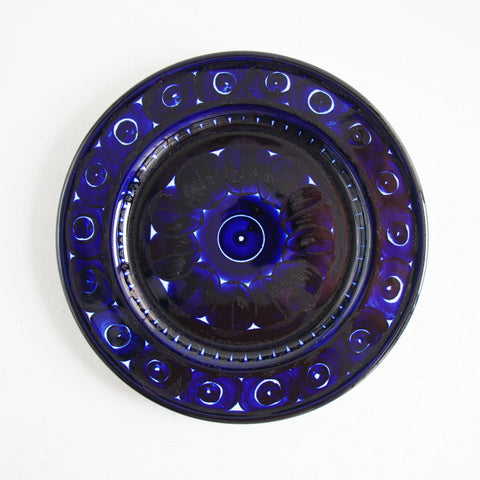
(Photo: ARABIA's classic item, "Valencia ." If you look closely, you can see that the designs vary depending on the painter.)
The phenomenon of "paint loss," in which decoration peels off, is particularly common with decorations that use transfer paper. This can occur for a variety of reasons, including the original transfer paper being thin, being exposed to bleach, or not being pressed down enough. Paint loss can also occur over many years of use at home, with areas frequently rubbing against the paint becoming bald.

(Photo: Paint loss, a common sight at Berså in Gustavsberg . The leaf stalk where the cutlery would touch is missing.)
The paint loss mentioned above occurs due to wear and tear over many years of use. Nordic vintage tableware is tableware that is often used daily as it is practical. Therefore, the more popular the series of tableware, the more likely it is that paint loss will be seen.
On the other hand, faience is made using an ancient technique in which the piece is painted before firing. If you notice any chips in the faience design, it is often not just paint loss but a scratch on the piece itself.
About cutlery marks
Cutlery is a general term for metal tableware such as knives, forks, and spoons. In the Japanese lifestyle, wooden utensils such as chopsticks are often used, but in Scandinavia, the utensils used to bring food to the mouth are basically all made of metal. As a result, the surface of the ceramic is constantly coming into contact with metal. Over many years of use, this damage will become apparent as "cutlery marks." Usually, these marks are only visible when held up to the light, but the more used the tableware, the more long, thin lines will be visible near the center.

(Photo: Cutlery marks visible when held up to light. Cutlery marks are usually concentrated in the center.)

(Photo: Cutlery marks on a vintage Bersa. Vintage tableware is more susceptible to scratches because the ceramic is fired at a lower temperature than modern tableware.)
At our store, tableware with even the slightest cutlery marks (tableware that has been used) is usually rated as ★★★★☆ (4: Excellent condition) or lower. If there are very slight scratches that appear to have been caused by storage rather than use, we rate it as ★★★★☆ (4.5: Excellent condition).
About Crazing
Ceramics are made by applying a coating liquid called glaze, which is made from plant ash, to the raw material, china clay, and then firing it at high temperatures. When the glaze is heated to high temperatures, a component called silica contained in the raw material melts and turns into glass. This glass coats the entire ceramic like a thin mucous membrane, creating a transparent, hard coating that protects the tableware from scratches and stains.
The temperature inside the furnace during firing reaches a high of about 1,200 degrees, but gradually lowering the temperature and controlling the temperature during the cooling process is extremely difficult, and if it is cooled too quickly, spider web-like cracks may appear in the glaze. When cracks appear only in the glaze, even if there is no problem with the clay itself, this is called crazing.

(Photo: Crazing with pigments fixed)
Crazing allows moisture to penetrate the clay itself, so if a white piece of pottery has crazing, pouring a dark colored liquid like coffee into it will cause the color to set and never fade. While there is no problem using the pottery, the beauty of the pottery will be marred.
On the other hand, in the world of Japanese tea ceremony, for example, the flavor is created when matcha soaks into a tea bowl with crazing, and there is also a value in the idea that the bowl develops over the years of use. Crazing is not necessarily a defect in the ceramic, but rather, depending on how you look at it and how you think about it, it can even lead to an aesthetic sense that makes the bowl look beautiful.
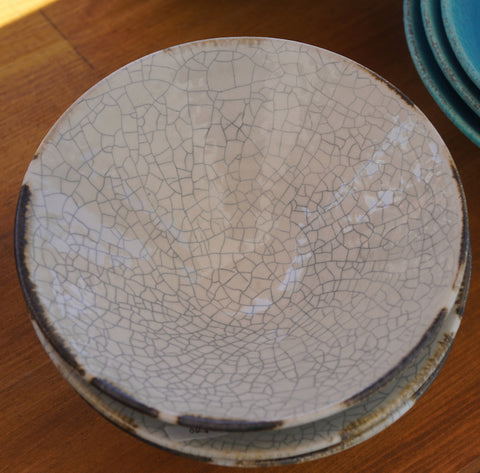
(Photo: Intentional crazing seen on a Tenmoku tea bowl)
While there are cases where it is clearly considered to be dirt, crazing can also be considered a unique feature in some cases, so the presence of crazing alone does not always allow for a value judgment as to whether something is good or bad.

(Photo: Crazing on the ceramic plate. Because the blue glaze is applied thickly, small crazing inevitably occurs in the glaze. This is due to the manufacturing process, and the crazing is not particularly noticeable.)
In most cases, Scandinavian tableware is shipped as is even if it has crazing. In the inspection system at the time when vintage tableware was made, crazing was not considered a damage to the product, and it was shipped and sold in the same way as genuine products. In Japan, crazing is considered a scratch or damage, but in Scandinavia, it is not considered a defect, which is a cultural difference.
About the remains of the pillars
There are two methods for firing ceramics in a kiln: "single firing" and "layer firing." Single firing is a method in which ceramics are fired one by one on the firing shelf of the kiln so that they do not touch each other.

(Photo: A single-piece plate. The red clay base is visible only on the base where the glaze is not applied.)
On the other hand, layer firing is a technique in which plates are placed on top of each other, and then several more are stacked on top of that, in order to save space and for mass production. A support, called a kiln stand, hearth, or tochin in Japan, is placed between each piece of pottery stacked vertically. Because the parts that touch the kiln stand during firing are not glazed, the finished product will have indentations left by the support. These support marks can almost always be seen on vintage Scandinavian tableware.

(Photo: Brown clay can be seen where the support hits the pot.)
The marks on the support posts are not defects or scratches on the product, but are a natural result of the manufacturing process. In the case of vintage products, the clay inside may be exposed and appear brown, but this is not dirt. Please understand that this is one of the characteristics of the product.

(Photo: The brown foot seen at Berså in Gustavsberg . This is not dirt, but rather the earth color of the base is exposed because no glaze is applied during firing.)

(Photo: The clay under the pottery is often seen through ARABIA's Valencia pottery . The high base of the pottery does not allow the fire to circulate easily inside the kiln, so the glaze does not adhere well and the earth color is visible.)